
How Texting Yourself Can Help You Stop Procrastinating

You’ve got a task. You know you should do it. But somehow you don’t. Turns out, messaging yourself that task might be the nudge your brain actually responds to.
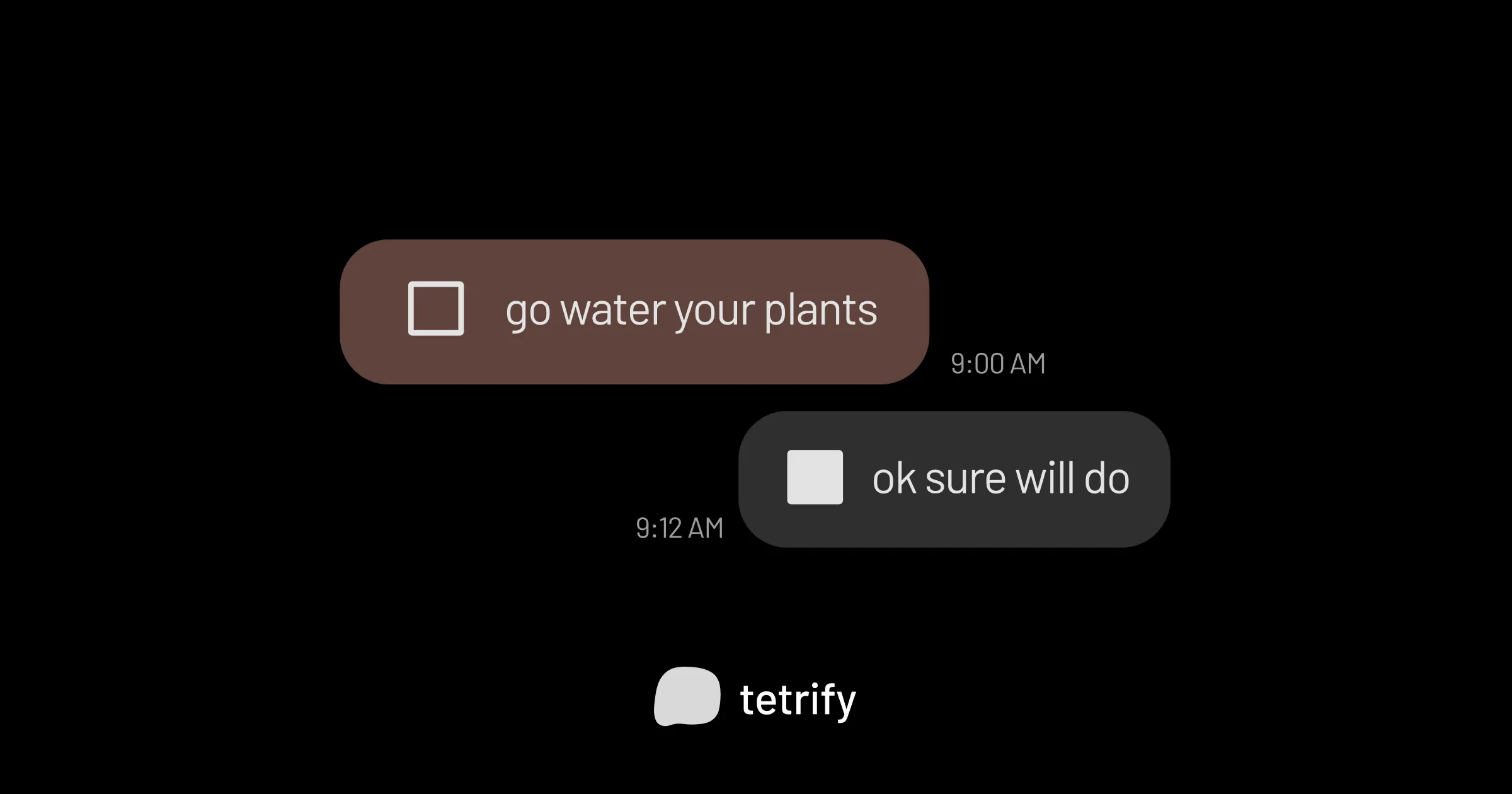
The Procrastination Trap
Section titled “The Procrastination Trap”We’ve all been there. There’s something you need to do — reply to an email, schedule that appointment, finally deal with that thing — and yet hours pass. Days, even. It’s not that you forgot. You just… didn’t do it.
The weird part? You probably thought about it multiple times. It floated through your mind while you were scrolling, eating lunch, or trying to fall asleep. But thinking about something and actually capturing it somewhere actionable are two very different things.
This is where most productivity systems fail. They ask too much of you in the moment. Open an app. Find the right project. Decide on a due date. Assign a priority. By the time you’ve done all that, the motivation has evaporated — or worse, you’ve talked yourself out of adding it at all.
Why Texting Yourself Actually Works
Section titled “Why Texting Yourself Actually Works”There’s something almost sneaky about texting yourself a task. Your brain doesn’t register it as “productivity” — it registers it as communication. And we’re wired for communication.
When you send a message, there’s a tiny sense of completion. You’ve told someone. The fact that the someone is you doesn’t seem to matter. Your brain still gets that small hit of “okay, I’ve done something about this.”
But here’s the real trick: you’ve moved the task from a vague mental loop into a visible, concrete place. It’s no longer bouncing around your head. It’s sitting in your messages, waiting. And because you check your messages constantly anyway, you can’t avoid it forever.
The “Two-Second Rule” of Capture
Section titled “The “Two-Second Rule” of Capture”Productivity nerds love to talk about friction. The less friction between having a thought and capturing it, the more likely you are to actually write it down.
Texting yourself is about as low-friction as it gets:
- You already have your phone in your hand (be honest).
- You already know how to send a message.
- There’s no decision about where it goes — it just goes.
Compare that to opening a dedicated task app, navigating to the right list, and filling out fields. By the time you’ve done all that, your brain has moved on. But texting? That takes two seconds. The thought goes from your head to your screen before your inner procrastinator can object.
From Capture to Action
Section titled “From Capture to Action”Of course, capturing a task isn’t the same as doing it. But it’s a crucial first step that most people skip entirely. Once something is written down — especially somewhere you’ll see it repeatedly — it has a much better chance of actually getting done.
There’s also a subtle accountability thing happening. When you text yourself “call the dentist,” you’re making a tiny promise. And every time you open your messages and see it sitting there, you feel that promise tugging at you. Not in a guilt-inducing way, just in a “yeah, I should probably do that” way.
Eventually, the act of texting yourself becomes a habit. Task pops into your head? Text yourself. Idea you don’t want to lose? Text yourself. Something you’ll forget if you don’t write it down immediately? You know the drill.
When Basic Texting Isn’t Enough
Section titled “When Basic Texting Isn’t Enough”The downside of texting yourself in a regular messaging app is that there’s no structure. Your tasks pile up alongside random notes, photos, and links. After a while, you’re scrolling through a wall of messages trying to find that one thing you sent yourself last Tuesday.
You also can’t mark things as done, set reminders, or organize tasks into categories. It works beautifully for quick captures but starts to fall apart when you need to actually manage what you’ve captured.
That tension — loving the simplicity, needing more structure — is exactly what led us to build tetrify.

tetrify turns texting yourself into a real system
Same familiar chat interface, but with checkboxes, reminders, and multiple spaces to keep your tasks organized. No account or internet needed.